Members of IFEX and civil society partners call on Tunisian authorities to free those unjustly imprisoned for documenting human rights violations, and to end the abuse of laws to persecute those who exercise their rights to free speech.
This statement was originally published on gc4hr.org on 30 July 2026.
We, the undersigned members of IFEX and civil society partners, appeal to the Tunisian authorities to stop imprisoning journalists and human rights defenders in violation of international law. There is a pattern of sentencing to prison those who criticise government policies, human rights violations or corruption, during trials that lack the minimum international standards.
Among those recently sentenced are well-known journalists Zied El-Heni, Sonia Dahmani and Haythem El-Mekki, and prominent human rights defenders Saadia Mosbah and Sihem Bensedrine.
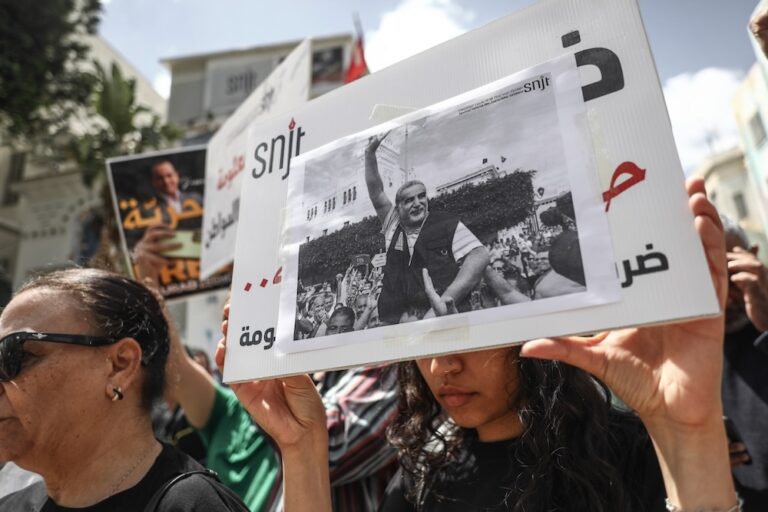
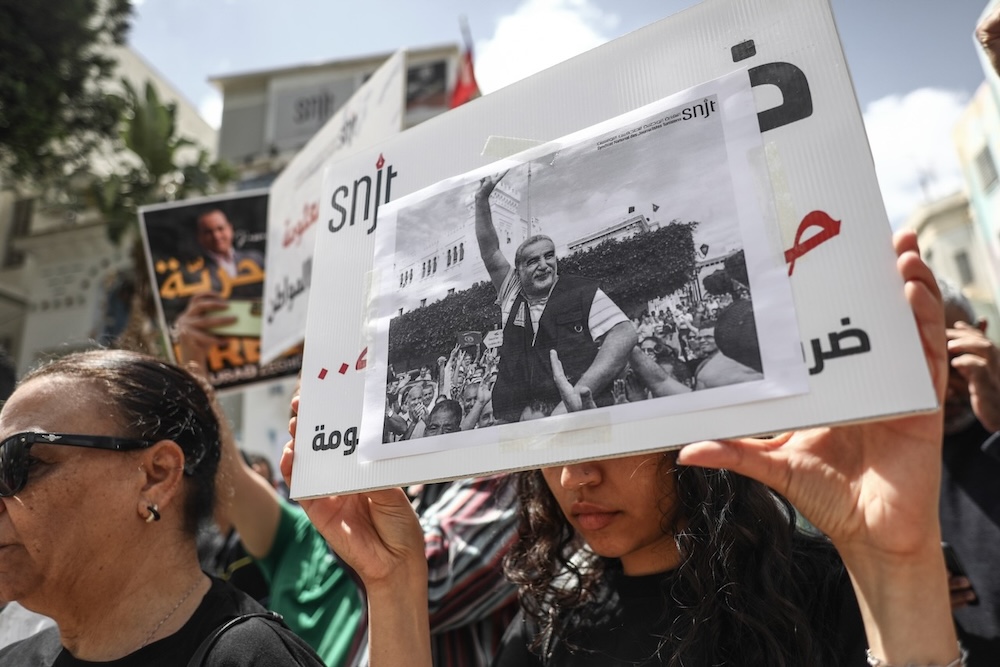
Zied El-Heni, a founding member of the National Union of Tunisian Journalists (SNJT), was sentenced to one year in prison on 7 May 2026 for social media posts critical of the authorities. He was tried outside the framework of Tunisia’s Press Freedom Decree-Law No. 115, on defamation charges filed without any prior individual complaint – a clear violation of press freedom standards. On 26 June 2026, El-Heni’s sentence was upheld by a judge in the correctional chamber of the Tunis Court of Appeal.
He was sentenced on charges of “harm to others” under Article 86 of the Telecommunications Code for social media posts in which he criticised the unjust sentencing of journalist Khalifa Guesmi, who spent three and a half years wrongfully imprisoned, and a National Guard officer who died after being detained. He was sentenced for calling those responsible “criminals”.
In a separate unrelated case, on 9-10 June 2026, El-Heni was targeted in the “Carthage municipal property” case along with four former municipal officials. On 30 June 2026, the criminal chamber of the Tunis Court of First Instance postponed the trial to an undetermined date, and rejected the release requests filed by El-Heni and his co-defendants. The legal basis of this case concerns a property exchange dating back to 1967 when El-Heni was three years old, leaving it highly suspect that El-Heni bears responsibility in this case. As an adult, he served on the Carthage municipal council with the cultural affairs portfolio, and had no authority over property matters.
It should be noted that these cases are taking place in a time of extreme heat where the court rooms are very hot. Within the span of four days, El-Heni was transported to court twice, both times in a windowless prison van, in the middle of a severe heatwave, alongside other detainees, and left handcuffed for hours without water, leaving him in pain and incapacitated.
Among other journalists prosecuted in Tunisia recently for public comments critical of the authorities, Sonia Dahmani was sentenced to another two years in prison on charges related to criticising inhumane prison conditions from her prior sentences, at a hearing on 22 May 2026 at the Tunis Court of First Instance. She is appealing the sentence, and remains conditionally free after spending time behind bars on various charges related to her comments about harsh treatment of migrants in Tunisia. She is also facing charges of criticising the wave of arrests in Tunisia.
Previously, on 11 May 2024, Dahmani was violently arrested by masked men who stormed the Tunis Bar Association headquarters after she made a sarcastic comment on television about racism against migrants in the country. On 30 June 2025, a Tunis court sentenced her to two years in prison. She was convicted three times under Decree-Law 54, the so-called “fake news” law used to silence dissenting voices. She was sentenced to a total of four years and two months in prison, and was detained at the Manouba Women’s Prison, under harsh and humiliating conditions. On 27 November 2025, Dahmani was released after spending more than 18 months in prison, following a conditional release order issued by the Ministry of Justice.
On 15 July 2026, Haythem El-Mekki, a columnist and satirical journalist with the independent media outlet Rachma and Radio Mosaïque FM, was sentenced to one year in prison by the Sfax Court of Appeal, which overturned a lower court’s dismissal of charges following a social media post about problems at the Habib Bourguiba University Hospital.
Among human rights defenders sentenced harshly this year is Saadia Mosbah, the co-founder of Mnemty (“My Dream” in Arabic) Association for Combating Racial Discrimination in Tunisia, which advocates for racial equality and on behalf of victims of racial discrimination in Tunisia. Her work has focused on combatting prejudice against migrants and promoting migrant and refugee rights. Mosbah was arrested on 6 May 2024 on false accusations of financial crimes, as perceived retaliation for comments about human rights violations of migrants. On 19 March 2026, the Tunis Court of First Instance sentenced Mosbah to eight years in prison and a fine of over €36,000. The Court also handed down fines and prison sentences of one to three years against other colleagues from the Mnemty Association. The sentence was upheld on 26 June 2026, and Mosbah and her colleagues filed an appeal.
Prominent human rights defender Sihem Bensedrine is awaiting appeal after being sentenced to a combined 25 years in prison in two cases related to her work as President of the Truth and Dignity Commission (TDC) from 2014 to 2018. Bensedrine was arrested on 1 August 2024 and held in Manouba prison, where she carried out a hunger strike to protest the charges against her, until her release on 19 February 2025. She was sentenced on 26 June 2026 by the Court of First Instance of Tunis to 10 years and 15 years on charges of “fraud,” “use of forged documents,” and “abuse of official capacity to harm the administration,” as a result of the Commission’s final report, specifically the chapter concerning corruption in the banking sector. The TDC was established under Organic Law No. 53 of 2013 on Establishing and Organizing Transitional Justice, and Article 69 stipulates that TDC members and staff are not responsible for its contents. She remains free while awaiting appeal.
These are just a few cases that form part of the backsliding of human rights in Tunisia, in which civil society is being targeted with retaliation.
Recommendations
We, the undersigned NGOs, call on the Tunisian authorities to:
- Free those unjustly imprisoned on charges related to freedom of expression, and their work documenting human rights violations, and drop all charges against them;
- End the abuse of laws such as the Telecommunications Code and Decree-Law 54 to persecute journalists for exercising their rights to free speech;
- Stop imprisoning government critics on false charges related to so-called financial crimes, corruption or fraud; and
- Ensure that those held in prison are treated humanely and fairly, including while attending trials.
Also, as the alarm has been sounded on Tunisia for a long time in recent years, we call on all the international mechanisms including the United Nations system to publicly condemn the Tunisian government’s repression and take actions to stop the massive human violations.